AI Trading Analytics: Beyond Charts and Tables

Can AI help traders discover their real trading edge?
AI-powered trading insights inside the Trademetria platform.
Trading journals have long been essential tools for traders looking to improve performance. By recording trades and reviewing past decisions, traders begin to understand what works and what doesn’t.
However, traditional analysis tools — such as charts and performance tables — still require manual interpretation. As trading data becomes more complex, extracting meaningful insights becomes increasingly difficult.
This leads to a deeper question many traders ask:
Do I actually have a real trading edge?
Answering that question requires more than visualizing data. It requires analyzing patterns, behaviors, and performance across multiple variables.
This is where AI-powered trading analytics are transforming modern trading journals. Instead of simply displaying data, AI helps traders interpret results, uncover patterns, and generate meaningful insights.
Some platforms, like Trademetria, are already moving in this direction — combining broker syncing with AI-powered analysis to automatically generate journal entries, enable AI chat with trading data, and deliver clear, actionable insights.
Rather than just tracking trades, this approach helps traders continuously analyze their behavior and identify patterns that may impact performance.
1. AI Connects Multiple Variables That Charts Cannot Easily Combine
Multi-variable performance analysis inside the Trademetria trading journal.
Traders often analyze performance one variable at a time — such as strategy, asset, or time of day. While charts can visualize these metrics, they rarely reveal how multiple factors interact simultaneously.
AI can analyze many variables at once, revealing relationships that would be extremely difficult to identify through manual chart analysis.
This type of multi-variable analysis can reveal when a strategy truly performs well — a critical step toward identifying a potential trading edge.
Here are some questions traders could ask:
Which strategies perform best during the first hour of the trading session?
(Variables: strategy + time of day)
How does my performance change when trading different assets at different times of day?
(Variables: asset + time of day + performance metrics)
Do I perform better when using smaller position sizes with certain strategies?
(Variables: position size + strategy + performance)
Is my win rate higher when trading breakout strategies in the morning compared to the afternoon?
(Variables: strategy + time of day + win rate)
Which assets generate the most consistent results for my breakout strategy?
(Variables: asset + strategy + consistency of results)
2. AI Identifies Hidden Performance Patterns
AI can detect relationships between market conditions, strategies, and outcomes that would be extremely difficult to identify through manual analysis.
By analyzing large datasets of historical trades, AI trading tools can highlight subtle patterns in performance that might otherwise go unnoticed.
These hidden patterns often reveal where a trader’s true strengths may lie and where adjustments may be needed.
3. AI Turns Trading Data Into Direct Answers
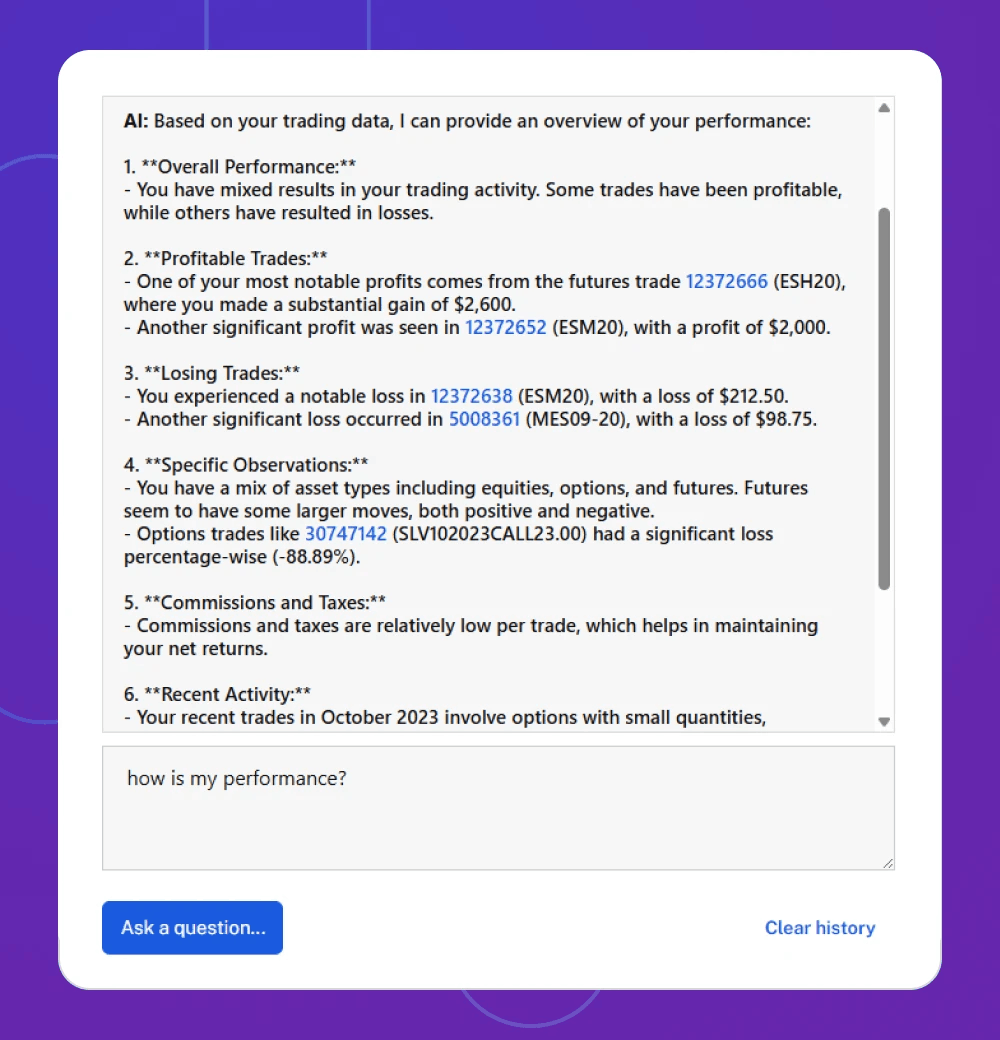
AI trading journal chat analyzing trading performance in Trademetria.
Some modern trading journals now allow traders to chat with their trading data, asking questions and receiving instant insights based on their trading history.
Instead of manually building charts and reports, traders can simply ask questions such as:
- What causes most of my losses?
- Which setups perform best?
- When does my performance decline?
AI analyzes the trading data and provides explanations, making the learning process significantly faster.
This conversational approach allows traders to interact with their trading analytics in a much more intuitive way.
4. AI Reduces Cognitive Bias in Trade Reviews
Reviewing past trades objectively can be difficult. Traders naturally interpret results through the lens of their expectations and beliefs.
AI-powered trading analysis can help reduce this cognitive bias by evaluating data more objectively.
By highlighting weaknesses, inconsistencies, and unexpected trends, AI can help traders gain a clearer understanding of their real performance.
5. AI Saves Traders Hours of Manual Analysis
Maintaining a trading journal is essential for improvement, but reviewing trades and building reports can take a significant amount of time.
AI-powered trading journals simplify this process by automating several key tasks.
Automatic journal entries
AI can generate structured journal entries directly from synced trade data, reducing the need for manual documentation.
Automated analysis
Instead of manually creating reports and charts, AI can analyze trading history and highlight patterns, trends, and potential issues.
A faster feedback loop
Because analysis happens continuously, traders can identify patterns and adjust their strategies much faster.
Charts and tables will always remain an important part of trading performance analysis. But as trading data becomes more complex, tools that help interpret that data are becoming increasingly valuable.
AI-powered analytics represent a new layer of intelligence for modern trading journals — transforming raw trade data into meaningful insights and faster learning.
Platforms like Trademetria are beginning to integrate these capabilities, allowing traders to combine traditional performance tracking with AI-driven trading insights that help reveal deeper patterns in their trading behavior.
For traders searching for consistency — and perhaps even a true trading edge — this type of analysis can make a significant difference.