The 6-step process to better trade journaling

Most traders already know they should keep a trading journal.
The problem is that recording trades is only the beginning.
A journal becomes truly valuable when you use your trading history to answer important questions:
- Why am I making money?
- Why am I losing money?
- Which strategies actually work for me?
- Which instruments are hurting my performance?
- When do I trade at my best?
- What mistakes keep showing up?
- What should I change in my trading plan?
The problem isn't always that you don't know how to trade. Often, you simply don't have enough data to see why you're winning or losing.
With the right process, your trading history can become one of your most valuable tools for improving your performance.
Here is a simple six-step process you can follow.
1. Record Every Trade
Don't rely on memory.
Your memory is not a reliable trading database. After hundreds or thousands of trades, it becomes almost impossible to remember the details that matter.
Start by recording your trades in one place.
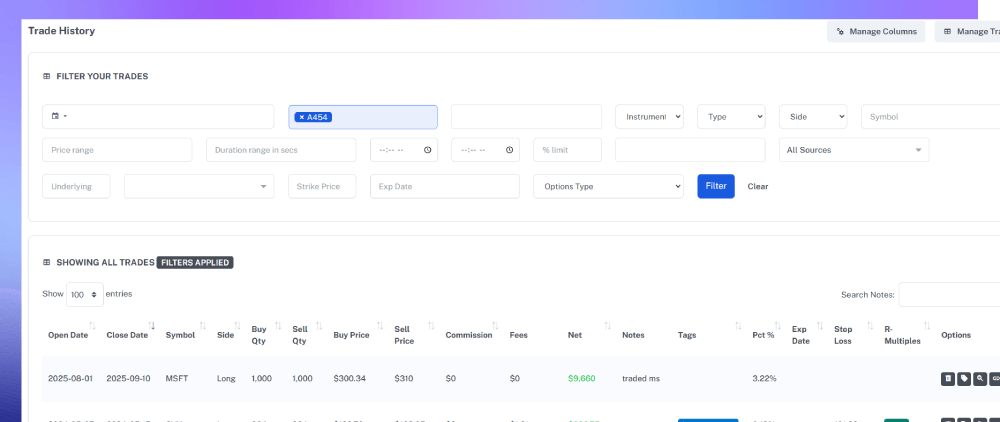
With Trademetria, you can import trades automatically or upload them from your broker. You can then keep your entries, exits, notes, strategies, and screenshots together with your trading history.
But don't stop at importing the trades.
Add the additional information that can help you understand your decisions later. What was the setup? Why did you enter? Did you follow your plan? Was there something unusual about the market?
The more useful information you capture, the more questions your data can eventually answer.
The goal isn't simply to create a database of trades. It's to create a database of decisions.
2. Tag What You Were Trading
Once your trades are recorded, start organizing them.
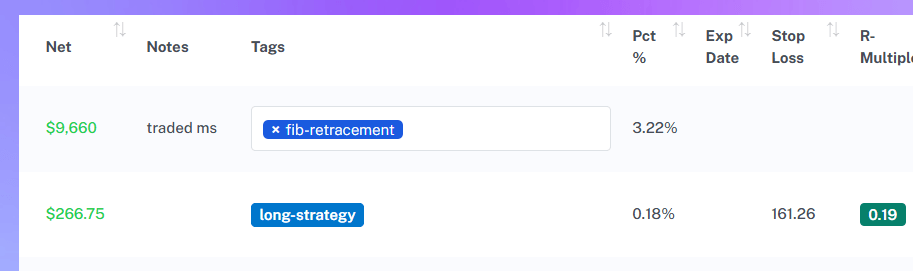
Add tags for the things that matter to your trading:
- Strategy
- Setup
- Market condition
- Mistake
- Direction
- Trading session
- Entry type
- Exit type
- Anything else that helps describe the trade
Why does this matter?
Because a trading account can show you that you made $5,000 last month. But that number doesn't tell you **how** you made the money.
Maybe one strategy generated $7,000 while another lost $2,000.
Maybe your morning trades were consistently profitable while your afternoon trades gave back most of your gains.
Maybe one particular setup has a strong win rate while another consistently loses money.
Without categorizing your trades, these patterns can remain hidden.
Tags turn a long list of trades into meaningful groups that you can compare.
3. Find What's Actually Working
This is where your trading journal starts becoming a decision-making tool.
Instead of asking:
What do I think is working?
You can ask:
What does my trading history prove is working?
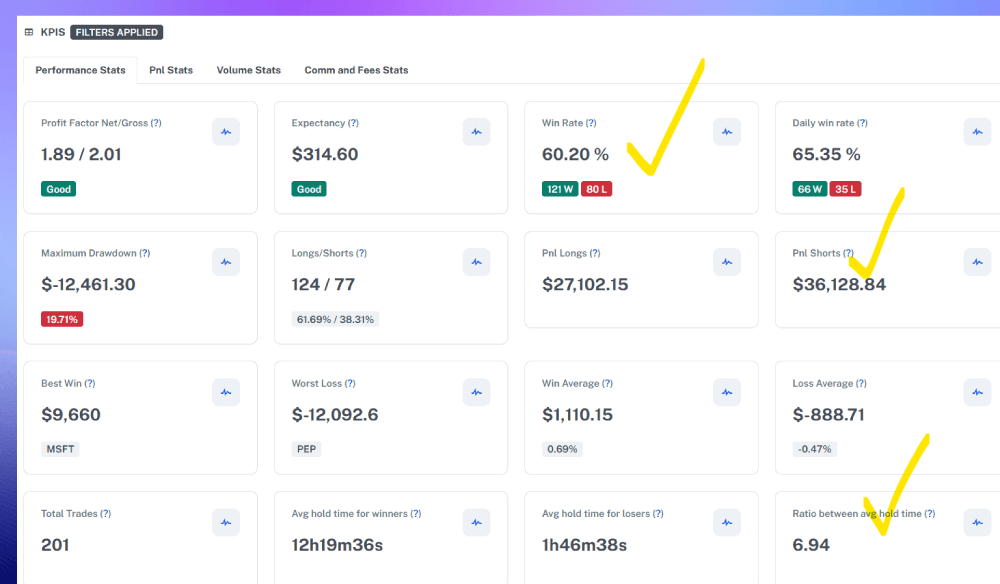
Review your performance by strategy, instrument, direction, time of day, and other conditions that matter to your trading.
For example, you might discover that:
- One strategy produces most of your profits.
- A particular instrument consistently performs better for you.
- Your performance is stronger during a specific trading session.
- Your average winning trade is significantly larger for one setup.
- A strategy you thought was profitable is actually losing money.
These insights can change the way you trade.
Start by reviewing your key performance statistics and looking for patterns.
4. Find What's Hurting Your Results
Finding your winners is only half the equation.
You also need to understand what's hurting your performance.
Look for patterns behind your losing trades.
- Are you giving back profits in the afternoon?
- Are you holding losing trades too long?
- Are certain setups consistently underperforming?
- Are there instruments that look attractive but consistently lose money for you?
Your data can help answer these questions.
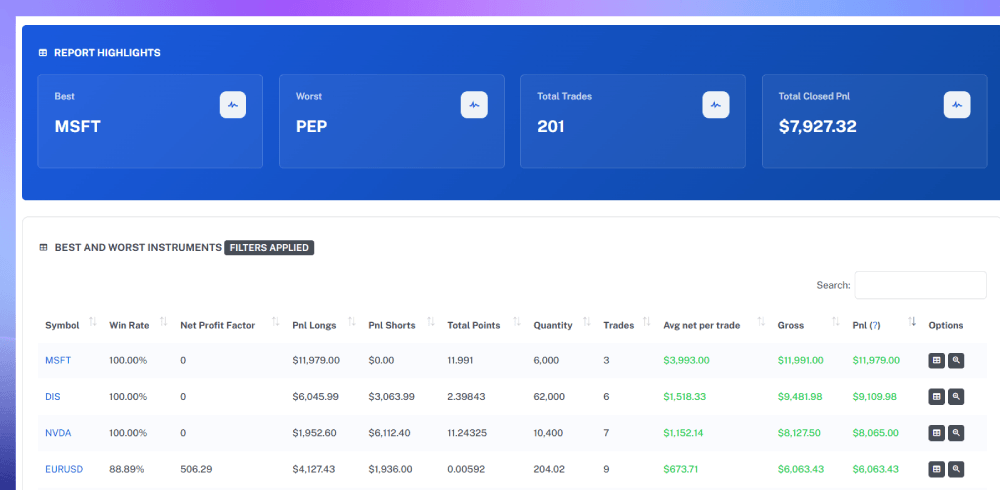
One useful place to start is your instrument performance. Compare the assets you trade and identify which ones are contributing to your results and which ones are dragging them down.
Then drill down further. Look at individual assets or tickers and examine how your performance changes across different time periods and conditions.
The objective isn't to eliminate every losing trade. Losing trades are part of trading.
The objective is to identify repeatable patterns that are costing you money.
5. Turn Your Findings Into Rules
Finding a pattern isn't enough.
You need to turn that information into an actionable trading plan.
Suppose your data shows that one particular setup consistently performs well while another consistently loses money.
You could simply remember that finding.
Or you could turn it into a rule.
Define:
- Which setups you want to trade.
- Which setups you want to avoid.
- Which market conditions you prefer.
- How much risk you're willing to take.
- When you should stop trading.
- Which behaviors you want to eliminate.
Then test your ideas.
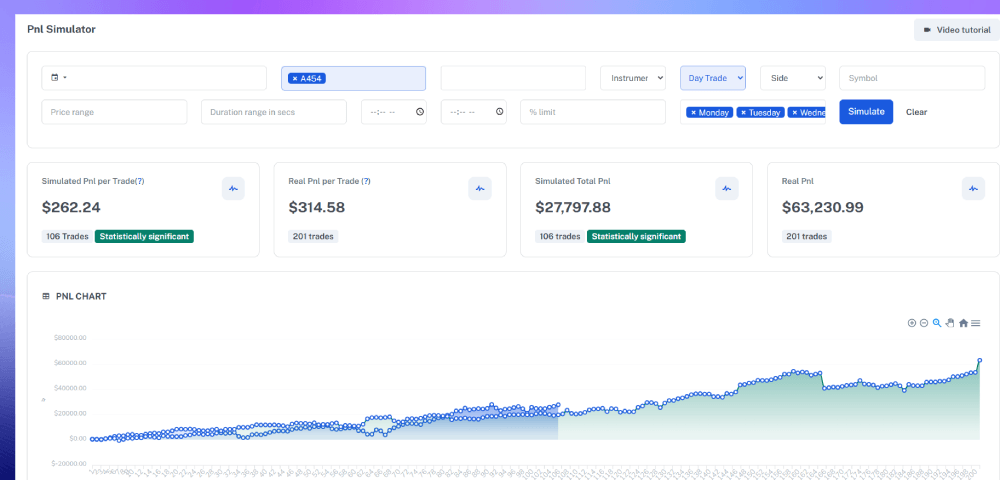
Use historical data to simulate how your new rules would have performed in the past. This doesn't guarantee future results, but it can help you determine whether an idea deserves further testing before you incorporate it into your trading process.
Once you've identified a setup or approach that makes sense, turn it into a strategy that you can follow consistently.
The goal is to transform observations into rules.
6. Review. Adjust. Repeat.
Don't expect one review to change everything.
Trading improvement is an iterative process.
Trade. Record. Review. Learn. Adjust. Then repeat.
As your trading history grows, you'll have more data to work with and a clearer picture of your strengths and weaknesses.
You may discover that a strategy works better than you originally thought. You may discover that a particular habit is costing you money. You may even discover that some of the things you believed about your trading simply aren't supported by the data.
That's valuable information.
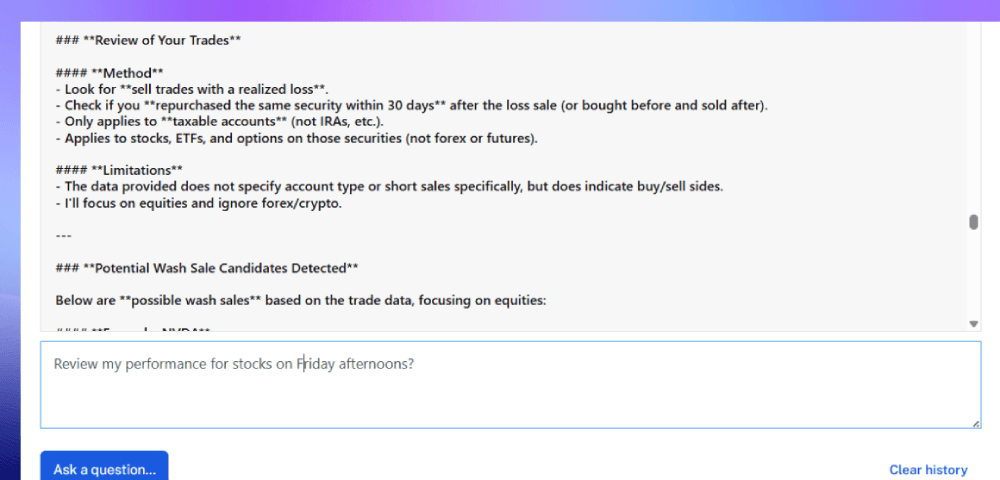
And when you have questions about your results, you don't have to analyze everything manually. Trademetria's AI Coach can help you analyze your trading history and uncover additional insights.
Your Trading History Can Be Your Best Teacher
That's the real value of a trading journal.
You don't just record what happened.
You use your trading history to understand **why** it happened, identify patterns, test ideas, and make better-informed decisions going forward.
Every trade adds another piece of information.
Every review gives you another opportunity to learn.
And over time, those small insights can become a much more disciplined and data-driven trading process.
The Data Is Already There. Use It.
After analyzing 240,000 orders and 100 million shares traded, we found that traders who used Trademetria consistently made 15.2× more profits than those who didn't.
You can read the full analysis in our $3 Billion Trading Case Study →
The important takeaway isn't that a trading journal magically makes someone profitable.
It's that your trading history contains information about your behavior, decisions, strategies, and results.
The question is whether you're using that information.
Import your trading history, review your statistics, find one thing you can improve, and start building a more data-driven trading process.
Better trading starts with better data.